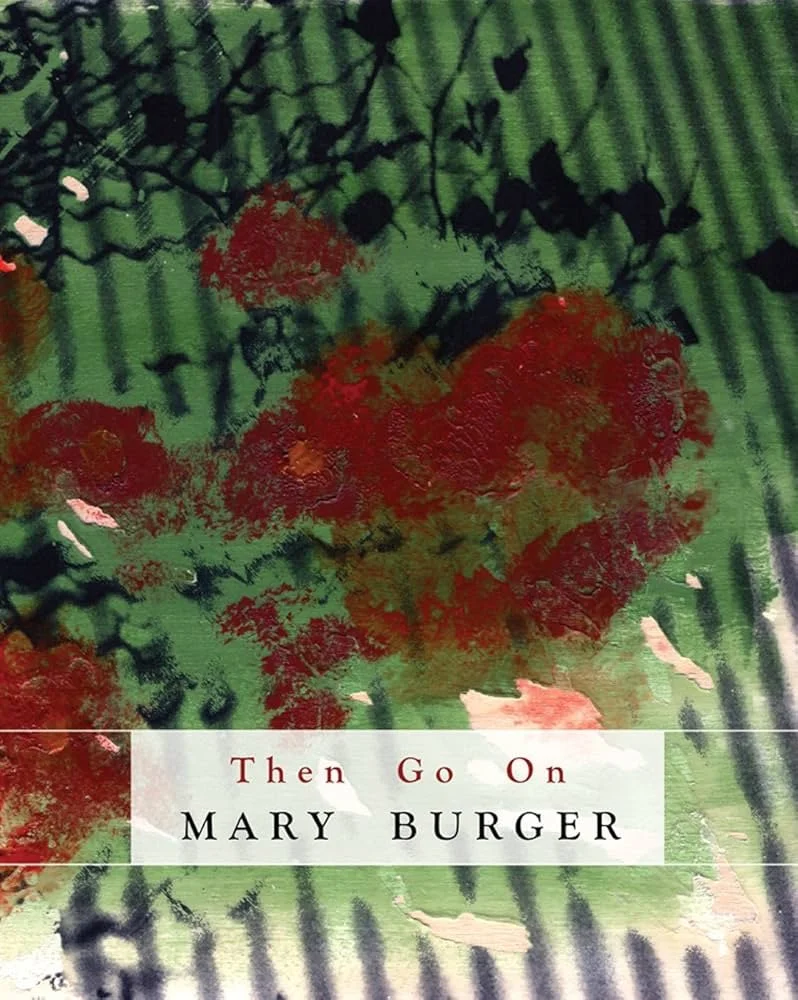
Then Go On
A collection of short prose works that borrow from languages of science, philosophy, and literary theory to examine private crises and epiphanies
ISBN: 978-1-933959-14-6
Litmus Press, 2012
About
Then Go On is a collection of prose works in which the sentence serves as a navigational device for plotting a course through different registers of language and attention. Detail, speculation, and inquiry combine in mismatched scales and perspectives, held together by a slim insistence that one must make it to the end of the line. In Then Go On, Burger explores how the idioms of rational inquiry—science, philosophy, reportage—can be turned back on themselves in self-reflexive critiques of certainty. For Burger, the gestures and habits of thought can provide patterns for optimism, even when thought itself yields no clear path. Serial moments highlight gestures of thinking and imagination without ever yielding to the fluidity of an ideal form; the obligatory shape of the sentence creates imperfect containers for matters that don’t fit there.
Praise
"The mind at work in Mary Burger's Then Go On is by turns exacting, passionate, tuned in to matters of scale as well as the functional paradox ('It is possible she was one of those who could steer the correct course only when she believed navigation was impossible'), and wholly unremitting in its drive to 'verify the veracity of perception.' Reading Then Go On has me reconsidering my notions of what certain surfaces—that of a person, a social identity, a piece of writing—can be."
—Anselm Berrigan
Excerpt
His Wrist
His wrist was not like me. His wrist was part of him and where he went his wrist went with him. I could know his wrist but not the way he did. I had attachment to his wrist. His wrist was like a movie. Like a movie I could touch. Between my thumb and fingers. His wrist was not transparent, it wasn’t like a movie that way. It reflected light. It moved in space and time, it was a movie that way. When the space and time in which I saw his wrist was gone, his wrist was gone. That’s the way it was a movie. It existed when I looked at it. When I couldn’t see it it was memory. An image in my mind. Just like a movie.
A wrist that didn’t know it was. What does a wrist know? He knew that he had one, he knew that he had two. If they were missing he’d be gone. His wrists would never leave without him.
Reading from Then Go On at The Old Stone House in Park Slope, Brooklyn. Video by Tyler Flynn Dorholt. June 30, 2012.