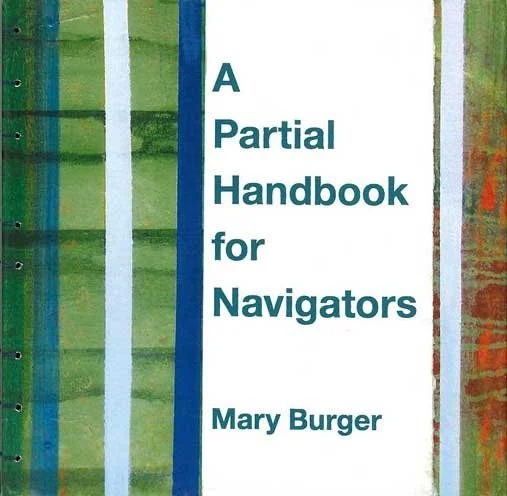
A Partial Handbook for Navigators
Writings on relationship to place
Limited edition of 100
Hand-bound using a traditional Coptic stitch
Cover art by Amy Trachtenberg: Rift Zone
Interbirth Books, 2008
Praise
"Although there are echoes of the essay, the serial poem, page-as-canvas spatial arrangements, memoir, and pose poetry, Burger sculpts and grafts these various divergent approaches into a new kind of writing, one which at its core is concerned with the exploration of ambulatory forms, with our false perceptions of stasis, and with momentary and mountainous delineations of time."
—Noah Eli Gordon
Per the writings of Sigmund Freud and Maurice Blanchot, human desire and human death haunt the five prose and poetry meditations that comprise this chapbook. Burger’s various riffs on the “rift” (starting with a detail from Amy Trachtenberg’s painting, Rift Zone), which opens up the part, the partisan (the section titled “A Series of Water Disasters” is an homage, in part, to guerilla activism) and partiality in general, shuttle back and forth between the narrator’s desire to convert the static noun (signaled here by the Golden Gate Bridge) into a verb. Burger mimics the noun, the name, by permitting almost all of her body, up to her neck, to be buried near Golden Gate Park, but this grave with a view — she observes passing “joggers, dog walkers, early strollers” — cannot replicate death (“It was nothing like being dead”) despite her desire for connection to earth, the noun and name, to, in brief, death: “I went looking for some recognition, on the earth’s part, or my part, that we were together.”
The “we" here is not only a gesture toward immanent, if not numinous, values of the dirt but also a vain attempt to be with her mother whose death is recorded in part four of “Water Disasters.” At the same time, the narrator’s burial up to her neck is not insignificant; the most startling section of the chapbook is “The Throat Smiles” which records the murder of a woman: her throat slashed, she is apparently dragged, or hurled, down a flight of stairs. I cannot reproduce the spacing of this particular poem here but its disjunctive, form, halting rhetoric and incomplete reportage offers another take on the rift, the divide. At the same time Burger recognizes the necessity, heretofore, of partiality. Neither a sentimentalist nor a rationalist, she turns from her mother ‘s “belief” in both religion and science: “Standing there in the sunny white passageway filling with seawater, with water that would not be still until the surface was level with the sea, I realized my mother’s faith would drown me.” It goes without saying that the strategy that Burger undertakes here, that of the bricoleur, can neither reject nor accept the modes of knowledge derived from our intuitive or rational inclinations. “How not to be silenced by all that one hears. // And when what is found requires further reading.” A Partial Handbook for Navigators is itself further—and farther—reading.
Excerpt
Notes from the Ground
It’s nothing like being dead.
I made an early-morning trip to lie in a shallow grave and watch the Golden Gate Bridge emerging from the fog. Karl and his friends placed shovels of dirt on me. He said tell him if it got hard to breathe.
It was workaday city dirt, gray, clumpy, littered with human detritus. No fragrant humus, no romance of fertility and renewal.
Karl and the rest drifted away to leave me alone with my interment. The weight of the soil pressed lightly, my head lolled on its earth pillow. I was immobilized, more by my complicity than by the weight itself. My hands at my sides, I was released from activity.
At grass-eye level, I flipped quickly through Horton hearing a Who, Gulliver stumbling over Lilliput. There were small things walking around down there. My point of view on the ground plane made knee-jerk reactions irrelevant. I stared at the Golden Gate, impressed by my private audience. A pelican flew low overhead, its usually-inaudible wing beats amplified. The perimeter revolved with joggers, dog walkers, early strollers. What would I tell them if any asked why I was lying here at seven in the morning with only my head above ground?
I went into the earth to find out if it was any different there.
I went looking for some recognition on the earth’s part, or my part, that we were together.
I find cemeteries especially interesting because they represent both the beginning and the end of landscape and architecture. Architectural historians are in common agreement that the tomb represents the very first attempt to create enduring built structures. –Ken Warpole
This structure was not a tomb and not enduring, not really a structure. Park caretakers would restore the sod after we left.
In early Europe and America, the dead were placed in small churchyards in bustling town centers, with austere slab headstones and no greenery to distract from the somber business of mourning. By the nineteenth century, the rise of Enlightenment secularism combined with a new public aversion to living near corpses and a growing romanticist taste for picturesque landscapes. A modern hybrid emerged: the rural cemetery. In these park-like settings, graves were arranged beneath groves of trees, and the leafy paths and vistas were designed as much for the pleasures of the living as for the remembrance of the dead. Families might take an excursion to the edge of the city, pay their respects to a forbear, and enjoy a picnic under the elms. The first of these destination cemeteries, Pere-lachaise, opened on the edge of Paris in 1803. Variations arose across the United States, from Mount Auburn near Cambridge to Mountain View in the Oakland hills. These early memorial/recreational sites organized the emotions in rambling but decorous arrays. White marble monuments in ancient Greek, Roman, or Egyptian style perched among landscapes designed for poetic, transcendental contemplation. As years went on, plantings became more ornamental, and the cemeteries came to resemble arboreta.
But within a century, it seems, the miniature cities of monuments and carefully framed views had become too sumptuous to encompass contemporary understandings of mortality, or of land use. Twentieth-century cemeteries began to emphasize utility and regularity, with little investment in design. Yet one among them stands out.
The Woodland Cemetery in Stockholm, begun in 1915, restored the use of simple slab headstones but scattered them among deep forest, with broad grassy slopes beyond. It was as if the churchyard cemetery were sprung from its pen and released into the countryside. The interspersing of natural landforms and modest stone markers evokes layered responses; here, we who’ve been born in the past hundred years or so can recognize some of the complexity of our mortal predicament. Swedish landscape architect Thorbjörn Andersson describes the effect as “feelings of landscapes of many different sorts, such as hope and happiness, sorrow and despair, death and resurrection. It is an environment full of feelings that facilitate contact between the inner and outer landscapes.”
Part disappearing act, part self-amplification.
My moment was nothing like death.
Rod’s father died the day before. It wasn’t unexpected. It wasn’t tragic. It was an end of a definite kind. He met me at Crissy Field after my voluntary interment to take a walk before he flew east for the funeral.
Everything is not a metaphor for everything.
It was nothing like being dead, but the comparison with a gravesite was inevitable. If this were to be my grave some day—this over-famous site that had been my youthful pilgrimage, the place where I became most alive—I would not live to regret it.